JavaScript ES6 Features Every Developer Should Know
Discover the most important JavaScript ES6 features including let, const, arrow functions, template literals, destructuring, promises, async/await, modules, and more with practical examples.
JavaScript ES6 Features Every Developer Should Know
JavaScript ES6 (ECMAScript 2015) introduced many powerful features that made writing JavaScript cleaner, faster, and easier to maintain.
If you're learning modern JavaScript, mastering ES6 is essential before moving to frameworks like React, Vue, or Node.js.
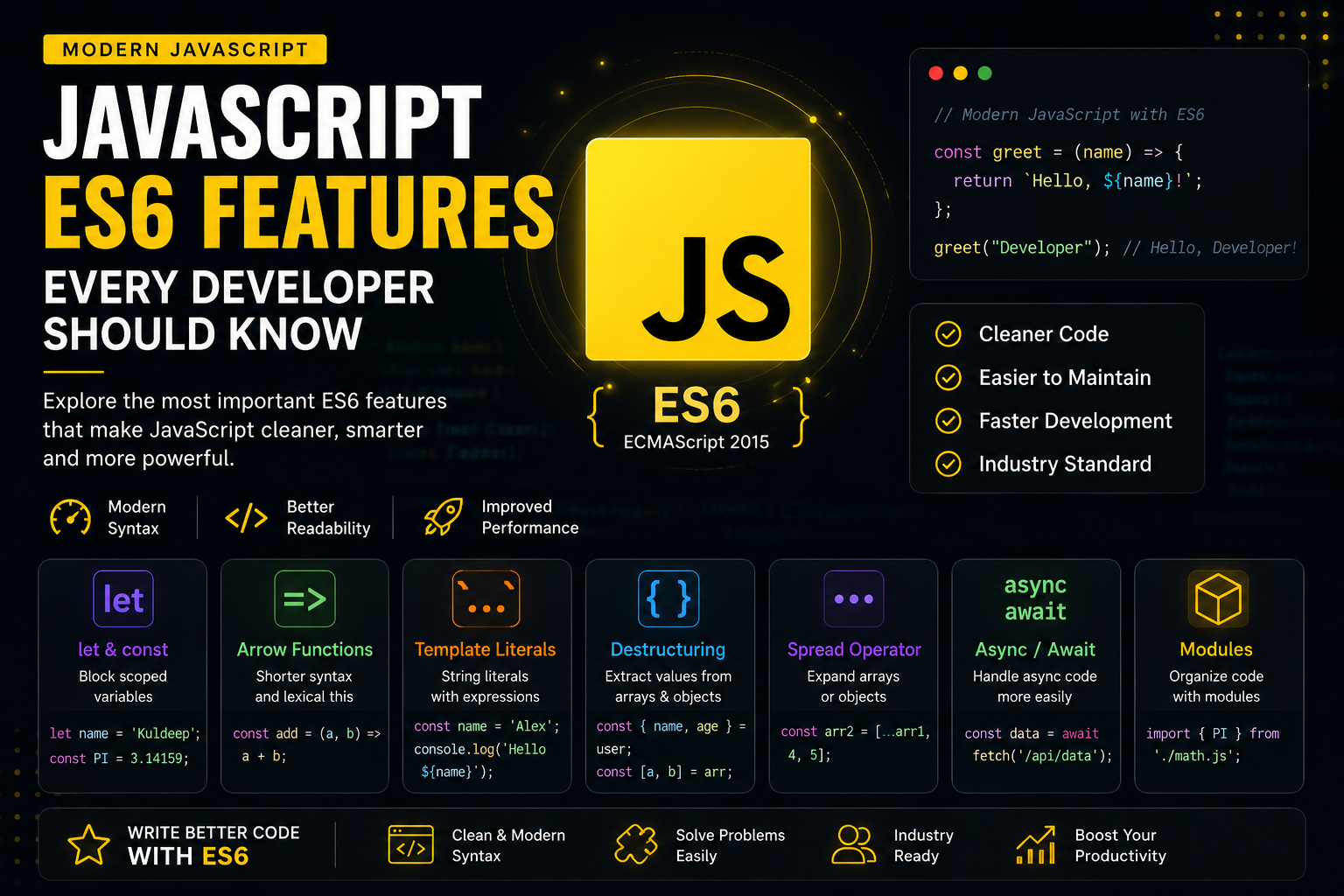
What is ES6?
ES6 stands for ECMAScript 2015, the sixth major version of JavaScript.
It introduced modern syntax and features that simplify development and improve code readability.
Why Learn ES6?
Benefits of ES6 include:
Cleaner syntax
Better readability
Improved performance
Easier asynchronous programming
Modular code
Reduced boilerplate
let and const
Before ES6:
var name = "John";Modern JavaScript:
let name = "John";
const PI = 3.14159;
Difference
var → Function scoped
let → Block scoped
const → Block scoped and cannot be reassigned
Arrow Functions
Traditional Function
function greet(name){
    return "Hello " + name;
}
Arrow Function
const greet = (name) => {
    return `Hello ${name}`;
};
Short Version
const greet = name => `Hello ${name}`;Benefits:
Short syntax
Cleaner code
Better handling ofthis
Template Literals
Old Way
var name = "Alex";
console.log("Hello " + name);
ES6
const name = "Alex";

console.log(`Hello ${name}`);
Supports:
Variables
Multiline strings
Expressions
Destructuring
Array
const colors = ["Red","Blue","Green"];

const [first, second] = colors;
Object
const user = {
    name: "Kuldeep",
    age: 21
};

const {name, age} = user;
Spread Operator
const arr1 = [1,2,3];

const arr2 = [...arr1,4,5];
Objects
const user = {
    name:"Kuldeep"
};

const updatedUser = {
    ...user,
    city:"Pune"
};
Rest Operator
function sum(...numbers){
    return numbers.reduce((a,b)=>a+b);
}

sum(10,20,30);
Default Parameters
function greet(name="Guest"){
    return `Welcome ${name}`;
}
Enhanced Object Literals
const name = "Kuldeep";
const age = 21;

const user = {
    name,
    age
};
For...of Loop
const numbers = [10,20,30];

for(const number of numbers){
    console.log(number);
}
Promises
const promise = new Promise((resolve,reject)=>{

    const success = true;

    if(success){
        resolve("Success");
    }
    else{
        reject("Failed");
    }

});
Async / Await
async function getData(){

    const response = await fetch("/api/users");

    const data = await response.json();

    console.log(data);

}
Advantages:
Cleaner than callbacks
Easy to read
Better error handling
Modules
Export
export const PI = 3.14;Import
import { PI } from "./math.js";Classes
class Student{

    constructor(name){
        this.name = name;
    }

    introduce(){
        console.log(`Hi, I'm ${this.name}`);
    }

}

const student = new Student("Kuldeep");

student.introduce();
Optional Chaining
Instead of
if(user && user.address){
    console.log(user.address.city);
}
Use
console.log(user?.address?.city);Nullish Coalescing
const username = null;

console.log(username ?? "Guest");
Essential ES6 Features
let & const
Arrow Functions
Template Literals
Destructuring
Spread Operator
Rest Parameters
Default Parameters
Classes
Modules
Promises
Async/Await
Optional Chaining
Nullish Coalescing
Best Practices
Prefer const over let whenever possible.
Use arrow functions for concise callbacks.
Replace string concatenation with template literals.
Use destructuring to write cleaner code.
Avoid callback hell by using async/await.
Organize projects using ES6 modules.
Keep functions small and reusable.
Comments (0)
No comments yet. Be the first to share your thoughts!